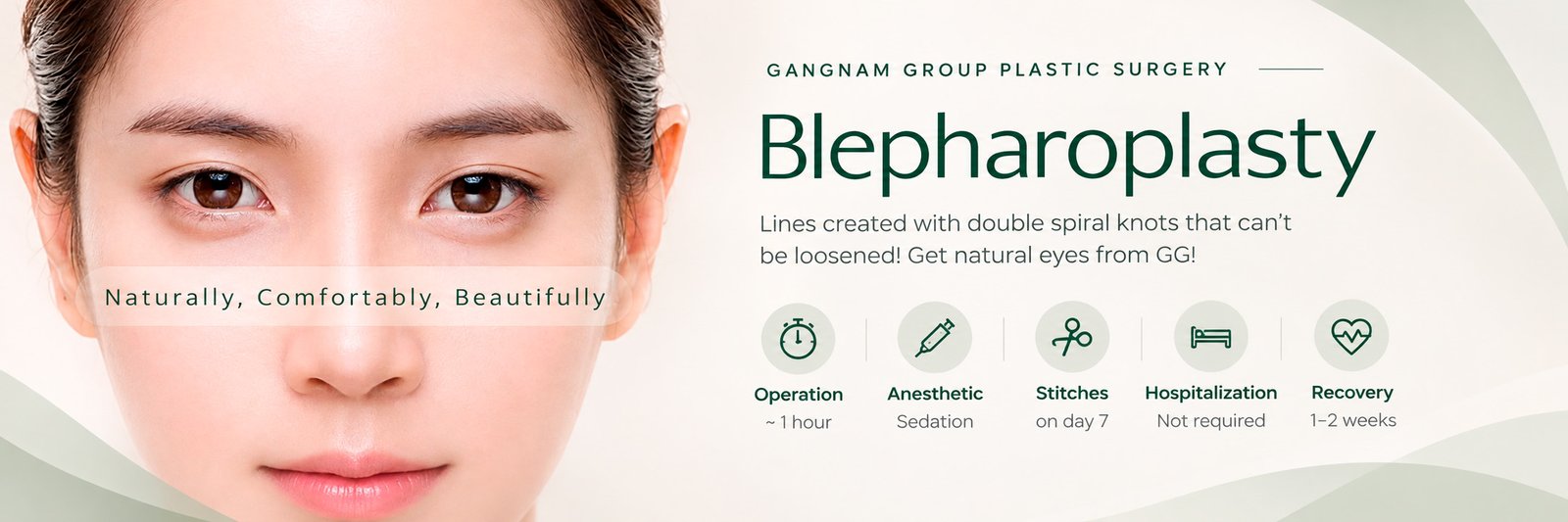

Blepharoplasty & Eyelid Surgery in Korea
Explore eyelid surgery techniques and receive personalized recommendations from Korean plastic surgeons. GGPS helps international patients compare treatment options and plan their visit to South Korea.
Request a Consultation Explore Procedures
A personalized approach to eyelid surgery
Explore surgical options designed around your anatomy, preferences and medical history. A consultation helps determine which procedures may be appropriate.
Explore procedures →Explore Eyelid Surgery Procedures
Choose a topic below to read the full explanation and view the original procedure illustrations. The appropriate technique depends on your anatomy, goals and medical assessment.
Double Eyelid Surgery — Overview
Double eyelids (sangapuri)
Some clients complain that their eyes look swollen and small due to the lack of a fold in their eyelids. Double eyelid surgery creates a fold in the upper eyelid, making the eyes look larger and brighter. There are three options for double fold surgery: non-incisional, partial incisional and incisional. The operation creates the effect of tightening the skin, creating a double fold and making the eyes look larger.
Non-incision method (no incisions)
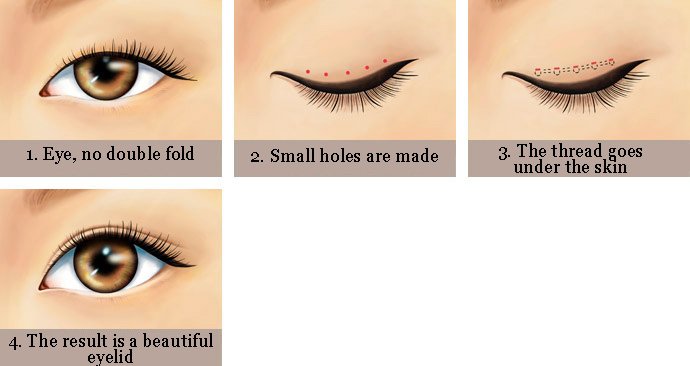
This method allows you to create a double fold without a cut. For this, small holes are made and special threads are used, with no any visible scars. It creates a natural look for the eyes.
Who is this procedure for?
- You have small eyes with a small drooping eyelid
- You have a busy schedule
- You want a natural result
- You may have complications with the incision surgery
Description of the procedure
The non-incisive operation or "pinch method" imply 3-5 holes to create a fold. The thread goes through the deep and surface tissues of the upper eyelid and pulls the skin together to create a crease.
Partially incisional method
This approach implies a combination of incisional and non-incisional methods. A small incision is used to remove the fat, and the fold is done with a thread.

Who is this procedure for?
- You have a thin eyelid with excessive fat, slightly drooping
- You don't want visible scars
- You want to reduce eye swelling
Description of the procedure
- A small incision is made to remove excess fat. The thread goes under the skin and natural looking folds are created.
Incisional method

It is a versatile surgical technique that can remove fat and tighten various tissues to achieve double fold. Surgeons are experienced and skilled in creating beautiful eyes with minimal scarring.
Who is this procedure for?
- You have swollen eyelids
- Your eyelashes touch your eyes
- You have asymmetrical eyelids
- You need a double eyelid revision surgery
- You want to have brighter eyes with a beautiful eyelid
Description of the procedure
- This method uses a full eyelid incision to create a fold while simultaneously correcting various eyelid tissues, i.e. skin, fat, muscles and eyelashes.
Epicanthoplasty — Overview
Epicanthoplasty and Eye Corner Surgery
Epicanthoplasty is a procedure that modifies the skin fold at the inner corner of the eye (the epicanthal fold). Depending on individual anatomy and treatment goals, it may be considered on its own or alongside double eyelid surgery.
Medial epicanthoplasty focuses on the inner corner of the eye. Lateral canthoplasty addresses the outer corner and is a different surgical technique. The most appropriate approach depends on eyelid anatomy, eye position and a surgeon’s examination.
Open the Medial Epicanthoplasty and Lateral Canthoplasty sections below to see the original medical illustrations and read about the individual techniques.
All procedures involve risks, including scarring, asymmetry and changes to eyelid position. Results and recovery vary.
Medial Epicanthoplasty
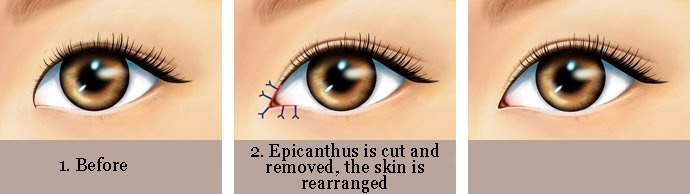
Changing the shape of the eye. The skin of the epicanthus (Mongoloid fold) is incised and corrected, as a result, the eyes become larger and more expressive.
Who is this procedure for?
- You have a Mongoloid fold (epicanthus)
- You have a high inner fold
- You have a large distance between your eyes
- You have the inner corners of your eyes down
- You want to enlarge your eyes
Description of the procedure
The epicanthus fold is removed. The remaining skin is corrected and shaped to the desired shape and angle. The stitch are hidden along the new line of the corner of the eye.
Lateral Canthoplasty
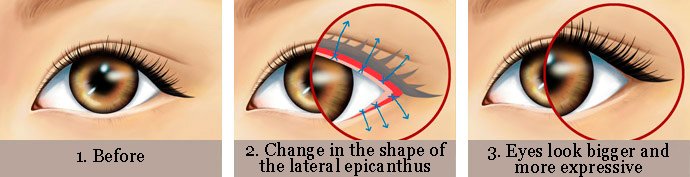
Changing the shape of the outer (lateral) corner of the eye to enlarge and give expressiveness to the eyes. The procedure is carried out by changing the lateral epicanthus. Also, this operation can change the angle of the eye. The shape and angle of your eye is individually adjusted by experienced surgeons to ensure the best possible result.
Who is this procedure for?
- You want to enlarge your eyes
- The inner corner of your eye looks up
- Your eyes are too close for medial plastic (epicanthus plastics)
- You have a strong fierce look
- Description of the procedure
- The outer skin around the eyes is opened and the mucous membrane is brought into position under the skin. Stitches are used to hold the shape in place.
Ptosis Correction
Weakening of the eye opener muscle (levator muscle) can cause the eyelid to sag and often make you look sleepy. Many people with this problem tend to start using the eyebrow muscles to open their eyes, thereby creating additional wrinkles and headaches. This treatment will strengthen the opening muscle of the eye for an easier eye opening and a more expressive gaze.
Who is this procedure for?
- You have sleepy eyes / tired look
- You have minor changes after double eyelid surgery
- You have asymmetrical eyelids (drooping, fold height, sunken eyes)
- You have a drooping eyelid symptom
* For patients with severely drooping eyelids, only the incisional method (surgical) is optimal.
Description of the procedure
1) Incisional method
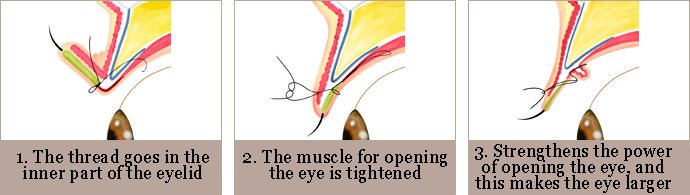
This method is also performed as an incisional double eyelid surgery. Additionally, the opening muscle is tightened and the power of the eye opening function returns.

2) Non-incision method
This method is used for people with minimal to moderate drooping eyelids who do not want to double fold or are afraid of incisions. For clients wishing to have a double eyelid, the procedure can be combined with a non-incisional double eyelid surgery. The opening muscles are pulled with a thread on the inner surface of the eyelids.
Upper eyelid blepharoplasty
As you age, the skin and fat above the eye can begin to sag. This treatment removes excess fat and lifts the sagging skin of the upper part of the eye. As a result, you get a young and fresh look.
Who is this procedure for?
- You have age-related sagging of the eyelid.
- You have vision blockage due to sagging eyelids.
Procedure Description This technique uses a full fold incision to remove excess fat and skin. The sagging in the tissue is corrected by lifting the remaining tissue.

Lower eyelid blepharoplasty
With age, the elasticity of the skin and the elasticity of the muscles of the lower eyelid decrease. Along with changes in the orbital fat pocket, this creates a tired look and makes you look old. Lower blepharoplasty can bring back the youthfulness of the lower eyelids by transferring and lifting the area.
Who is this procedure for?
- You have a lot of wrinkles under your eyes and droopy lower eyelids
- You have an eye sac (often in the elderly)
- You have reduced elasticity of the muscles of the lower eyelid
- You have ectropia (eversion of the eyelid) of the lower eyelid
- Description of the procedure
- A full incision is made directly under the lower lashes. A thorough dissection is performed, each component of the lower eyelid is examined and corrected: transfer of orbital tissue, tightening and hardening of muscles / skin. Excess tissue can be removed. Stitching is performed along the incision.

Bags under the eyes
Bags under the eyes make you look older and dark circles give you a tired look. This procedure can remove dark circles or lift bags under the eyes that have formed with age.
Removal of transconjunctive orbital tissue
Convex lower fat bags give a tired look and make you look older than your age, even if there are no wrinkles or saggy skin. This method will help remove excess fatty tissue through the inside of the eyelid without leaving scars.
Who is this procedure for?
- You have a slight bulge under your lower eyelid
- You have dark circles under your eyes
Description of the procedure
Using an incision on the inner surface of the lower eyelid (conjunctiva), it is possible to get access to the pocket of the orbital tissue. After opening this pocket, the fat is removed. Then the cut areas are corrected.
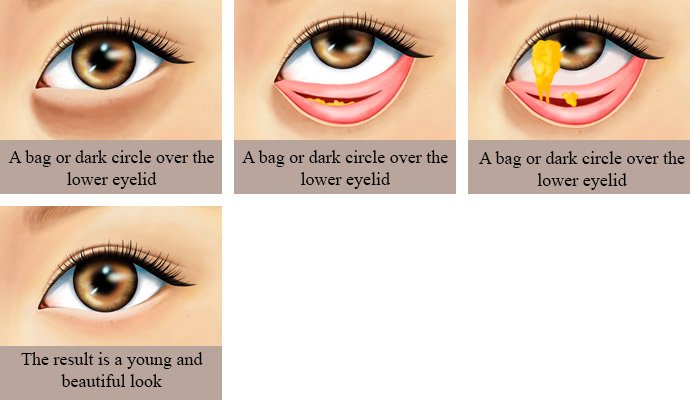
The illustrations are educational. Suitability, risks and recovery vary by patient and surgical technique.
Planning Eyelid Surgery in South Korea
1. Individual assessment
Share your goals, previous procedures and photographs so suitable surgeons can review your case.
2. Compare recommendations
Review suggested techniques, surgeon profiles and clinic quotations before deciding.
3. Plan your recovery
Allow time for follow-up appointments, possible suture removal and your surgeon’s travel clearance.
Recovery and important considerations
Swelling, bruising, temporary discomfort and changes in eyelid sensation may occur. Depending on the procedure, risks can include asymmetry, scarring, dry eyes, difficulty closing the eyes, changes in eyelid position and a need for further surgery. Rare but serious complications are possible. Your surgeon will explain the risks relevant to your examination and proposed technique.
Recovery schedules differ between incisional and non-incisional procedures. The recommended length of stay in Korea should be confirmed with your treating clinic before booking travel.

Discuss your goals with Korean surgeons
GGPS helps international patients seek individual recommendations and understand the differences between proposed surgical techniques.
View surgeons →Find the Right Eyelid Surgeon in Korea
Different eyelid procedures require different surgical approaches. GGPS helps international patients request recommendations from suitable Korean clinics, review proposed techniques and compare surgeon profiles before choosing where to proceed.
Recommendations based on your photographs, concerns and medical history.
Review treatment plans and clinic quotations, where available.
Coordinate consultations, surgery dates and follow-up arrangements.

Understand your options before deciding
Compare proposed procedures and request clinic-specific quotations. The final cost depends on the surgical plan and any additional care required.
Explore pricing →Blepharoplasty & Eyelid Surgery Prices in Korea
Compare indicative prices for eyelid surgery procedures in South Korea. These reference amounts are intended for planning; your final quotation is issued by the selected clinic after reviewing your individual surgical needs.
| Procedure | Approximate Price (USD / KRW) |
|---|---|
| Upper Blepharoplasty | $3,300 ₩4,400,000 |
| Upper Blepharoplasty with Ptosis Correction | $2,900–4,200 ₩3,850,000–5,600,000 |
| Upper Blepharoplasty, Ptosis & Fat Repositioning | $4,900 ₩6,600,000 |
| Lower Blepharoplasty | $2,500–3,300 ₩3,300,000–4,400,000 |
| Lower Blepharoplasty with SOOF / Midface Lift | $4,100–8,200 ₩5,500,000–11,000,000 |
| Revision Lower Blepharoplasty with Midface Lift | $5,700 ₩7,700,000 |
| Midface Lift (additional) | $4,900 ₩6,600,000 |
| Subbrow Lift / Subbrow Blepharoplasty | $2,500–3,000 ₩3,300,000–4,000,000 |
| Upper Eyelid Fat Grafting | $1,600 ₩2,200,000 |
| Under-Eye Fat Grafting (one session) | $1,600–1,900 ₩2,200,000–2,500,000 |
| Lateral & Lower Canthoplasty | $3,000 ₩4,000,000 |
| Epicanthoplasty | $800–1,300 ₩1,100,000–1,800,000 |
All prices are approximate. Korean won prices are the reference amounts; USD equivalents are rounded and may vary with exchange rates. The final fee depends on the surgeon, clinic, technique and complexity of the case. Confirm the inclusion of anesthesia, preoperative tests, VAT, medication and postoperative care in your individual quotation.
Request Your Personal QuoteRecovery & Staying in South Korea
Swelling, bruising and temporary discomfort are common. Follow your surgeon’s instructions for wound care and activity.
Some techniques use removable sutures, while others do not. The clinic will provide your individual follow-up schedule.
Plan your departure after the surgeon confirms that follow-up care is complete and travel is appropriate.

Plan your stay and follow-up care
Recovery schedules vary by technique. Arrange your follow-up visits and return travel according to the treating surgeon’s guidance.
Request consultation →Why Choose GGPS?
GGPS helps international patients explore eyelid surgery options in South Korea, compare recommendations and organize their treatment journey with greater clarity.
Surgeon Selection
Explore Korean plastic surgeons and clinics based on the procedure you are considering and your individual needs.
Compare Recommendations
Request opinions and quotations from suitable clinics, where available, before deciding on your treatment plan.
Personalized Approach
Recommendations take into account your concerns, photographs, medical history and preferred travel dates.
Clear Cost Information
Review clinic-specific estimates and clarify what is included, such as anesthesia, tests and follow-up visits.
Travel Coordination
Get assistance coordinating clinic appointments, possible surgery dates and practical details of your visit.
Recovery Planning
Understand the clinic’s recommended follow-up schedule and plan your stay around postoperative care.
Frequently Asked Questions About Blepharoplasty in Korea
How much does blepharoplasty cost in South Korea?
The cost of blepharoplasty in South Korea depends on the surgical technique, the surgeon’s experience, and the complexity of the procedure.
Below are reference prices for eyelid surgery at plastic surgery clinics in Seoul:
| Procedure | Approx. Price (USD) |
|---|---|
| Upper Blepharoplasty | $3,300 |
| Upper Blepharoplasty with Ptosis Correction | $4,200 |
| Upper Blepharoplasty with Ptosis Correction and Fat Repositioning | $4,900 |
| Lower Blepharoplasty | $3,300 |
| Lower Blepharoplasty with SOOF / Midface Lift | $8,200 |
| Subbrow Lift | $3,000 |
USD amounts are approximate, converted at 1 USD ≈ 1,339 KRW (October 30, 2026). Actual charges are determined by the clinic in Korean won and may vary with exchange rates. These are indicative prices rather than guaranteed quotations. The final cost depends on the selected clinic, the patient’s individual anatomy, and the recommended surgical plan.
GGPS helps international patients obtain personalized treatment recommendations and price estimates from plastic surgery clinics in Seoul before traveling to South Korea.
Why do international patients choose South Korea for eyelid surgery?
South Korea is a popular destination for eyelid surgery because of its specialized plastic surgery clinics, experienced surgeons, and wide range of surgical techniques.
Clinics in Seoul offer procedures for both Asian and non-Asian patients, including upper blepharoplasty, lower blepharoplasty, double eyelid surgery, and revision eyelid surgery.
Choosing the right surgeon and surgical approach is more important than selecting a clinic based on price alone.
What is the difference between upper and lower blepharoplasty?
Upper blepharoplasty addresses excess skin, fat, and other concerns affecting the upper eyelids. It may help improve the appearance of hooded or drooping eyelids.
Lower blepharoplasty focuses on under-eye bags, excess skin, and puffiness. Depending on the patient’s anatomy, the surgeon may remove or reposition fat to create a smoother transition between the lower eyelids and cheeks.
Both procedures can sometimes be performed during the same surgery.
What type of anesthesia is used for blepharoplasty in Korea?
Blepharoplasty in South Korea is commonly performed under local anesthesia, sometimes combined with intravenous (IV) sedation for additional comfort.
With IV sedation, patients are relaxed and may feel sleepy during the procedure, while local anesthesia numbs the surgical area to minimize pain.
General anesthesia is usually not required for straightforward eyelid surgery, although it may be recommended for more complex procedures or when blepharoplasty is combined with other facial surgeries.
The final anesthesia method is determined by the surgeon and anesthesiology team based on the patient’s health, surgical plan, and medical history.
How long does blepharoplasty take, and is hospitalization required?
The duration of blepharoplasty depends on the procedure and its complexity.
- Upper blepharoplasty: approximately 30–60 minutes.
- Lower blepharoplasty: approximately 60–90 minutes.
- Upper and lower blepharoplasty combined: approximately 1.5–2.5 hours.
- Blepharoplasty with ptosis correction or SOOF lifting: may require additional surgical time.
In most cases, blepharoplasty is performed as an outpatient procedure, meaning overnight hospitalization is not required .
After surgery, patients remain at the clinic for observation and recovery, usually for a few hours, before being discharged.
If IV sedation is used, patients should arrange for a responsible adult to accompany them after discharge and follow the clinic’s postoperative instructions.
An overnight hospital stay may occasionally be recommended for more complex surgeries or certain medical conditions.
How long should I stay in Korea after blepharoplasty?
International patients are generally advised to plan approximately 7 days in South Korea after uncomplicated blepharoplasty, depending on the surgical technique and recovery progress.
During this period, patients can attend postoperative examinations and have their stitches removed when necessary.
More complex procedures, revision surgery, or combined facial surgeries may require a longer stay. Your surgeon will confirm when it is safe to travel home.
How long does recovery take after blepharoplasty?
Initial recovery typically takes about 1–2 weeks. Swelling, bruising, and mild discomfort are common during the first several days.
Many patients feel comfortable returning to routine social activities within 10–14 days, although some swelling may remain.
Final results take longer to develop as the tissues heal and swelling gradually subsides. Recovery varies depending on the procedure and individual healing.
Will I have visible scars after eyelid surgery?
Incisions for upper blepharoplasty are commonly placed within the natural eyelid crease, helping scars become less noticeable as they heal.
For lower blepharoplasty, incisions may be placed just below the eyelashes or inside the lower eyelid, depending on the technique.
Scars usually become less noticeable over time, but individual healing varies, and completely invisible scars cannot be guaranteed.
What is the difference between lower blepharoplasty and SOOF lifting?
Lower blepharoplasty primarily addresses under-eye bags, excess skin, and fat-related concerns.
SOOF lifting (Sub-Orbicularis Oculi Fat lifting) targets deeper tissues in the upper cheek area. It may help improve the transition between the lower eyelid and cheek, particularly in patients with a pronounced tear trough or certain types of malar bags.
In selected cases, both procedures can be performed together through the same surgical approach.
What is the difference between blepharoplasty and ptosis correction?
Blepharoplasty primarily addresses excess eyelid skin and fat.
Ptosis correction treats drooping of the upper eyelid margin, which may occur when the muscles or structures responsible for lifting the eyelid do not function properly.
Some patients require both procedures to improve the appearance and position of their upper eyelids.
A surgical examination is necessary to determine whether ptosis correction is needed.
What is the difference between double eyelid surgery and upper blepharoplasty?
Double eyelid surgery creates or defines an upper eyelid crease. It is commonly performed using incisional or non-incisional techniques.
Upper blepharoplasty generally focuses on removing or repositioning excess skin and fat, although the procedures may overlap.
The appropriate technique depends on the patient’s eyelid anatomy, skin condition, and desired appearance.
How can GGPS help me arrange blepharoplasty in Korea?
GGPS provides medical tourism coordination services for international patients considering plastic surgery in South Korea.
Our services include helping patients identify suitable clinics, arranging preliminary consultations, obtaining treatment recommendations and price estimates, coordinating appointments, and assisting with travel-related arrangements such as airport transfers and accommodation options.
Surgical procedures, medical decisions, and postoperative medical care are provided by the selected licensed clinic and its healthcare professionals.
Contact GGPS to request a preliminary blepharoplasty consultation and receive personalized treatment recommendations from clinics in Seoul, South Korea.
Get a Personalized Eyelid Surgery Consultation
Tell us which procedures interest you. We can help you request individual surgical recommendations and estimated prices from suitable Korean clinics.
What Happens After You Submit Your Request?
#
R
E
A
L
S
T
O
R
Y

GG Story


#RealStory